Steve Holmes
From Hunted to Hunters
A dedication to my younger brother, Graeme Holmes.
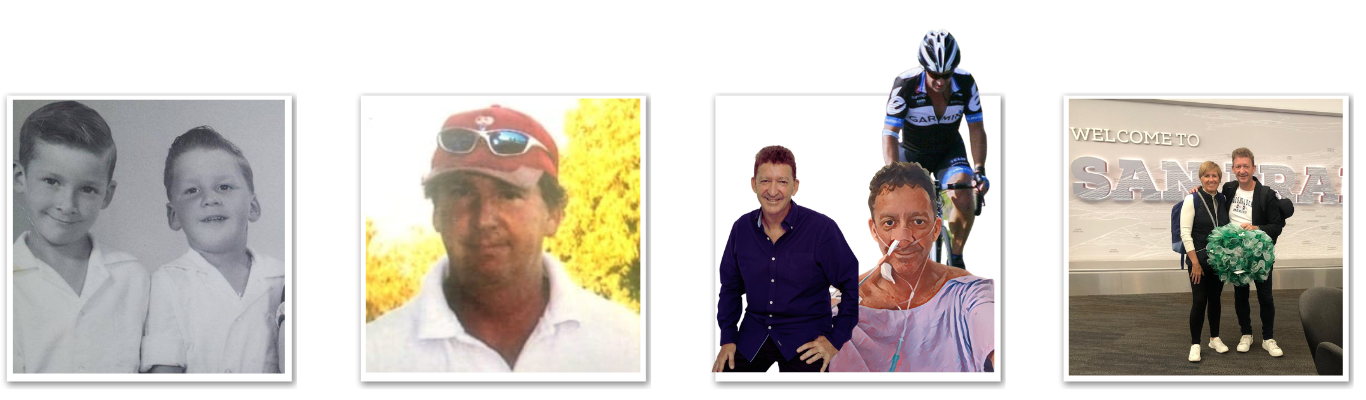
Left: Graeme and me. Centre: the journey from person to patient and back to person again. Right: Claire and me returning from the Cholangiocarcinoma Conference in Salt Lake City.
My younger brother Graeme and I were diagnosed with the same aggressive cancer.
Graeme died.
I survived.
This is the story of two brothers, two families and the same cancer. It is also the story of what changed between Graeme's diagnosis and mine, and why that difference changed the direction of my life.
The First Helplessness
When Graeme was diagnosed, none of us understood cholangiocarcinoma.
There was no roadmap for our family. No coordinated way to understand what was happening, what mattered most, or what questions we should be asking.
Graeme did what was asked of him.
I stood beside him and watched.
Graeme died at 52.
A wife lost her husband. Two children lost their father. His death changed his family, changed our family, and changed me.
Then It Came For Me
Not long afterwards, I was diagnosed with the same cancer.
Mine was distal extrahepatic cholangiocarcinoma, in a very similar location to Graeme's.
I underwent approximately 25 hours of major surgery. Weeks later, my main hepatic artery ruptured and I came close to dying.
Then the cancer returned.
Aggressively.
It spread across my liver and lungs. I had progressed to late-stage Stage IV disease, with very little time remaining.
The cancer was the same.
But this time Claire and I had already lived through what happened when understanding came too late.
The Opening
Tumour profiling revealed biological features that opened an opportunity to enter KEYNOTE-158.
By then I was extremely unwell.
Claire held my arm to the desk while I signed the trial consent form.
I received my first immunotherapy infusion in August 2017.
My breathing improved. Soon I could sit again, walk again and function again.
Nine weeks later, my scan confirmed a complete response.
I had survived a position from which very few people with cholangiocarcinoma survive.
What Changed
Graeme's death and my survival left me with a question I could not ignore.
I did not have a simple answer.
But I knew that I had reached my diagnosis carrying something Graeme and our family had not possessed when he was diagnosed: experience.
Claire and I understood more, questioned more and searched more widely. We knew that time mattered and that decisions could preserve or close options.
Survival did not give me all the answers.
Instead, it gave me a reason to keep asking better questions.
The Responsibility
Survival became the beginning of the work, not the end of the story.
Patients and families began contacting Claire and me.
At first, we shared what we had learned.
Before long, something became clear.
They needed a path.
They needed earlier understanding of the disease, the decisions in front of them, the options that could still be preserved, and what needed to happen next.
That work ultimately led Claire and me to found Cholangiocarcinoma Foundation Australia.
Over the years that followed, I worked directly alongside thousands of patients and families.
One exceptional survival became thousands of observations.
From Hunted To Hunters
Cancer hunted our family.
It took Graeme.
Then it came for me.
The shift was not pretending that a patient controls cancer.
It was understanding that a patient and family can become far more capable of responding to it.
It changes the questions we ask and when we act.
It helps preserve options that might otherwise disappear.
More importantly, it changes the role of the patient from someone simply receiving the system to someone capable of engaging effectively with it.
Where It Led
The work eventually moved beyond my own survival.
Thousands of patient encounters revealed patterns: where understanding arrived too late, where options were lost, where specialist expertise connected well, and where it did not.
Those observations led further into curative opportunity, surgery, earlier detection, the biliary system, bile, biological cause and prevention.
The other started with cancer and worked backwards towards cause.
Ultimately, they met in the same place.
Earlier understanding.
Two brothers.
Same cancer.
Graeme died.
I survived.
What we learned is now being put to work for others.
Steve
Copyright © 2026 Steve Holmes. All rights reserved. No part of this publication may be reproduced, distributed or transmitted without prior written permission, except for brief quotations used in reviews or other permitted non-commercial use.